Writer's desk

Thoughts and stationery

Kaweco Sport Review: The Perfect Gateway Fountain Pen — June 8, 2025

Kaweco Sport Review: The Perfect Gateway Fountain Pen

The Kaweco Sport fountain pen has broken free. It has escaped the confines of the stationery enthusiast and the shops they (we) frequent. They pop up everywhere – from trendy bookshops looking to diversify to chic ‘lifestyle’ boutiques and even museum giftshops. Finding one is simple.

That ubiquity is why it was one of my first fountain pens. It ticks all the boxers to make it a good, entry pen. It is affordable, comes a broad pallet of colour to match any style and can be found in all those shops above.

A review must cover some basic facts. The classic Kaweco Sport costs around $30/£22, is plastic (though metal versions are available) and comes with a gold or silver finish. It is light, at under 10 grams, and compact, around 10cm when capped. It slips easily into your pocket at the beginning of the day. It is a pen that wants to be with you everyday. But that means it can vanish without much effort – I have had to say goodbye to a mint Skyline version and still have no idea where it could have got to.

Easy to carry, easy to lose and easy to use – that’s the Kaweco Sport. It’s popularity means you can grab one in a range of nib sizes – from extra fine to double broad. Writing with it feels effortless; ink flows smoothly but doesn’t swamp the page. It glides. I can hardly remember it catching apart from on the worst paper.

Those nibs don’t take long to break in either – if they need any in the first place. The pen also takes the common short international standard cartridge, so you won’t have a problem finding ink you like. There is a converter available – though it isn’t the best quality. Mine leaked – staining the cap threads on my mint Skyline barrel which took a bit of work to get out. I’ve avoided the converter since and don’t feel the need to buy another.

So the Kaweco Sport is an easy-writing, accessible pen. Its otherwise basic design comes with one big flourish – its cap. Its distinctive octagonal shape is a smart feature – not only for its striking design but also since it means the pen won’t roll around your desk. The gold detailing works particularly well with the dark green version – part of the reason I got it.

But there is more to fountain pen than its design or how well it writes. Fountain pens can feel like ‘event’ pens when you first start using them. I had a feeling that I had to be writing something deep, meaningful and profound – something more elevated than jotting down a to do list before my memory leaked into the air rather than onto the page. The Kaweco Sport is a good pen and it is good in helping you get away from that thought.

It’s understated design also has another boon. While cheap, it still has a sense of sophistication about it – a quality all fountain pen enthusiasts are looking for. It won’t provoke a comment but it will be noticed. Your understated, sophisticated and discerning personality will glow through it – or to the extent that a £25 pen can allow.

If you enjoy the Kaweco Sport but are looking for a more sturdy version, there are aluminium and carbon fibre versions. Special and limited-time versions supplement the standard stable too – with added design elements and colours which may only be around for a short time.

The Kaweco Sport is a pen I would recommend. It can be an everyday pen while still having enough about it to make writing with it feel special. It’s a versatile, reliable writer that won’t weigh you down, empty your wallet or play hide-and-seek too often. That one drawback – being easy to lose – and the Sport is a good pen for someone only getting into fountain pens. For the more serious enthusiast, they can make good gifts too.

It’s a classic for a reason

Vital statistics

  • Nib size: Medium
  • Nib material: Stainless steel, gold plated
  • Price: £20.72 (Amazon) + Clip: £7.93 (Amazon)
  • Length: Capped: 105mm Barrel: 95mm Posted: 133mm
  • Diameter: 14mm
  • Weight: 20g
  • Material: Plastic

Other reviews:

Writing in pencil — April 13, 2020

Writing in pencil

The pencil can be mightier than the pen

Writing tools exist in a hierarchy of prestige. Their place in executive offices, at high-profile public signings and as gifts that mark the stages of life make the fountain pen king. Below it come ballpoint and rollerballs, gel pens and biros. The pencil, humble and basic, looks down only on crayons – if those can even be called writing tools. The pencil is the first writing tool we use and the first abandoned. We graduate from tracing specimen letters and rubbing out our first wobbly attempts in trails of graphite early. Our scrawls, early efforts at cursive, are replaced by more masterful strokes drawn in ink. We go from the grey of our first pencils to the blue ink of the schoolroom before we are urged to match the seriousness of the adult world in sombre black. This progression has us leave behind an evocative and tactile tool. As I took up pencils again, as I started to write for pleasure, I have fallen in love.


My pencil case and desk drawers are full of three pencils. Yes, there are the strays, those branded pencils you forget where you picked them up, but I write with ones I have sought out and bought. The Ticonderoga is my workman. Its name recalls the woods of a newly settled America, a wild Thoreau-like landscape. It is familiar. Its yellow and green livery is more remembered from school off the television than any real-life experience though. It is for teasing out an idea, a thought, capturing it quickly before it disappears. It is a composer of first drafts. Robust and quotidian, it leaves behind a line more grey than black. The pressure needed to make your mark is not inconsequential; it feels like there is some work going into your writing. Essays and jottings are constructed rather than flow which matches my experience of writing out an idea more fully. It admits mistakes. Not full rewrites of final edits, but its crowning eraser, the only lasting innovation in the four century history of the modern pencil, does let you catch those better word or better phrases that pop into your head the instant you see an inadequate cousin on the page. The Ticonderoga implies that things are not yet done.

Things progress. Drafts are rewritten. Your text begins to come together. To help marshal ideas and expression I turn to my Tombow Mono 100s. It is a smoother writer than the Ticonderoga. It keeps its point longer and writes in a more authoritative black. Its purpose is picked out in gold on black. It is for ‘hi-precision DRAFTING’. It is serious. It tidies and straightens, evens out and tunes up.

Humans create personalities. Our tools and appliances each have their own quirks. We imbue them with character. How we found them, where we found them, their branding, context and our own experience inform this character. There is some shamanesque magic in tools. Maybe it is how it focuses the mind on different things, maybe it is just an overactive imagination, but I can’t help but feel it. It is why I enjoy using pencils, using different ones.

The final one I keep close at hand is the world’s most famous pencil. For people who see a pencil or pen just as what they are, who have the good sense not to create personalities or mythologies for what is merely graphite encased in wood, that may sound strange. But the Blackwing 602 is celebrated around the world. Authors and writers praise it. For good reason too. The 602 sings across the page. The gruff grit and grumble a pencil makes as you drag it along the page is tuned and smoothed by the 602. When you’re ready, after the thinking and rethinking, after the edits and drafts, the 602 is there. It flows. It adds flourish. It is eccentric. Its cuboid eraser is weird. Its boasting of ‘twice the speed, half the pressure’ is arrogant. Yet, with its wax and graphite mix, it can carry it off.


Pencils are humble but powerful. It is your path into the whole written world. Writing gives our thoughts an existence outside of ourselves. The connection between pencil and paper is closer than that with pens. It has a friction, a noise, a rough and bumpy physicality that is not matched with silky ink. Pencils mark our progress. They get dull; our minds need sharpening. Roald Dahl used to start each writing day with six freshly sharpened Ticonderogas. When they were worn and their points were dull and thick, the work must have been done. I still like to write with pens. But there is a permanence to ink that I am not ready for when I am journaling or setting out on a piece. A pencil, its smells and sound, its reflection of the work put in, its allowance for mistakes, is the perfect tool. A pencil gives its life for your writing. It gives it life.

Sheaffer 300: Fountain Pen Review — August 23, 2019

Sheaffer 300: Fountain Pen Review

Pens, especially fountain pens, mean so much more than their function. Take the Shaeffer 300 for example. Or, more precisely, my Shaeffer 300. I could give you a product breakdown, my trying-to-be-objective thoughts but then that wouldn’t really be telling you about it.

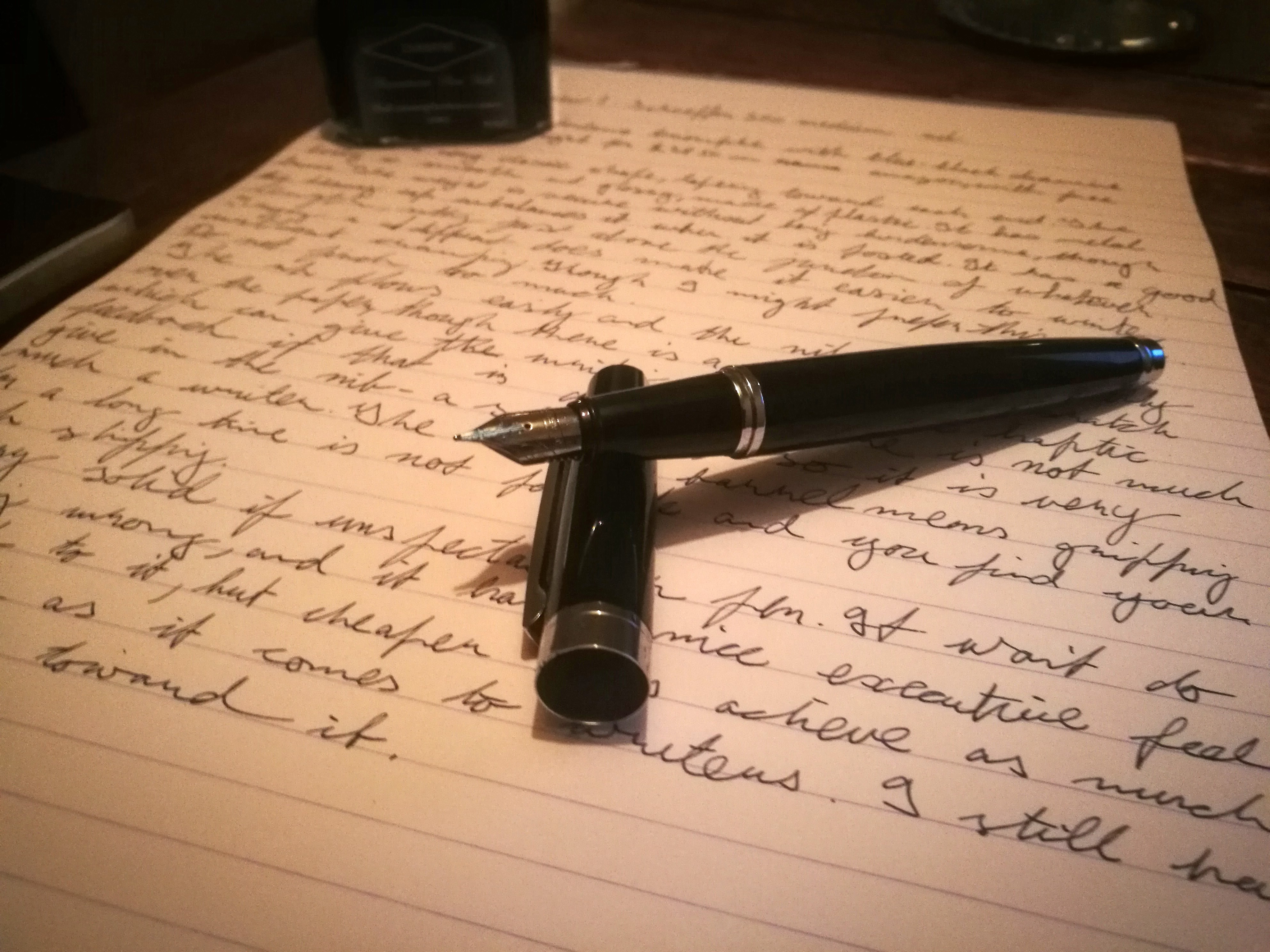
This pen is my oldest one. My parents gave it to me when I finished school. It was the pen I used when I first discovered the joy of writing with fountain pens. I could tell you that compared to some of the others I have got in the meantime, the Lamys, the Pilots, the Kawecos, it is a solid but unspectacular writer. It has a smoothness to it which is only interrupted by a tiny scratchiness which actually works to give you some nice feedback. The stiff nib doesn’t give much – there is little variation in line width.

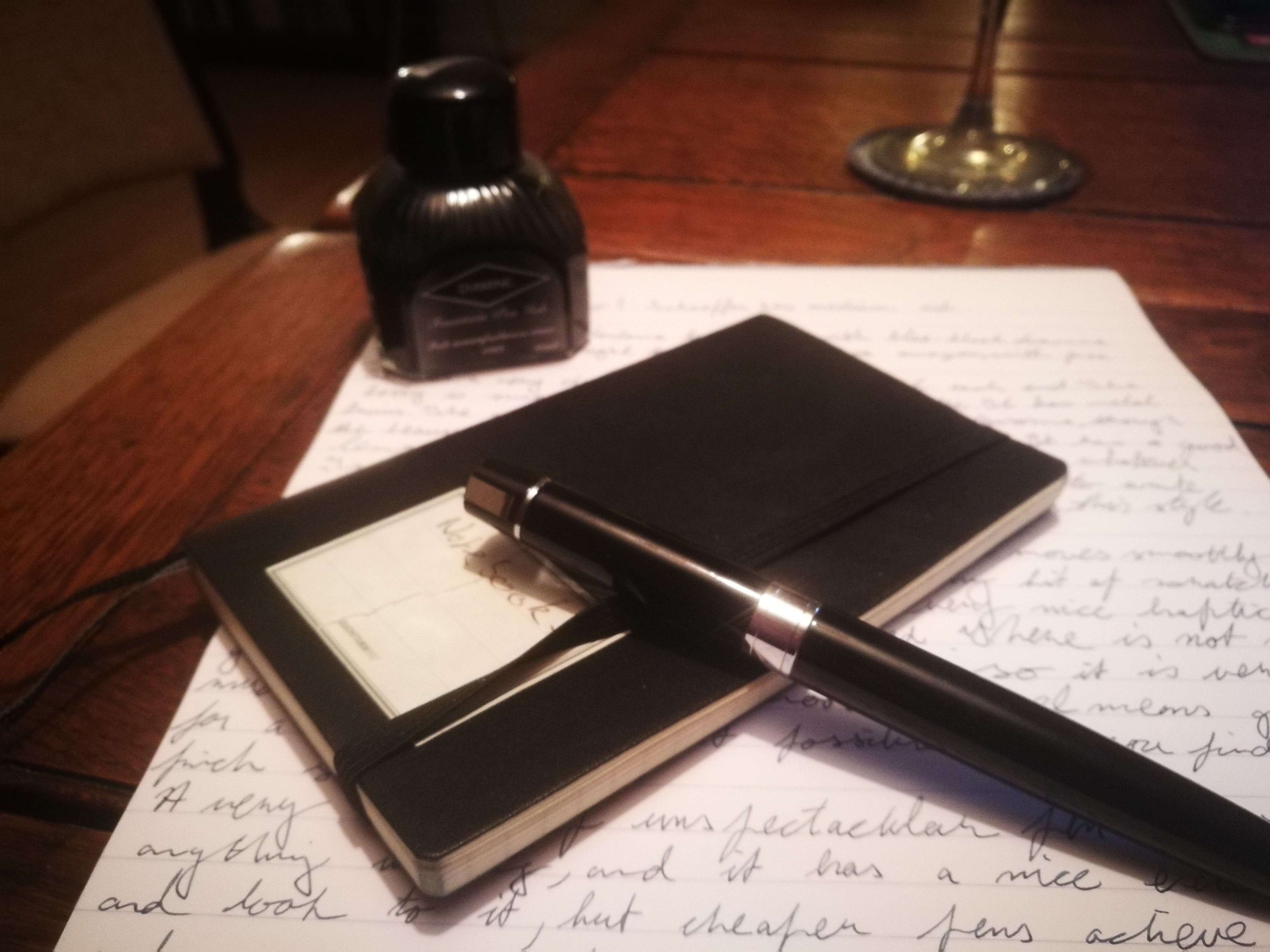
Sheaffer 300 Fountain Pen Review Capped

There are definitely some drawbacks to it though. The body is made out of smooth resin broken up by chrome finishings. It is a classic cigar shape, cut at both ends as if you were to smoke it. The grip tapers toward the nib but is smooth. It can be uncomfortable to grip it for a long time as you do have to pinch it. It is top heavy when posted, though the cap does some nice give to the clip. It feels like it was designed to actually sit in a pocket.

But it looks grown-up. I got it when I thought I was a grown-up, though I had a lot of growing up to do. Over the years I have had – now over a decade – I have changed and developed. I developed a love for stationery in general and fountain pens in particular. Coming into my own I found out it wasn’t the best pen you could buy. Even for the £38.50 (at the time of writing) you can get it on Amazon for right now it is beaten handily by a Pilot Metropolitan for looks and action. Even now I find myself reaching for a TWBSI Eco or Kaweco Sport.

Sheaffer 300 Fountain Pen Review Uncapped

But the love for fountain pens isn’t rational. I will write a piece about why fountain pens are great writing tools but I didn’t get into them because they were the best writers. A bic, at the end of the day, records the same thing on the same paper. The cristal doesn’t need to be cleaned, it can be easily carried on a plane. You don’t mess up your hands every time it runs out of it. But a bic is ugly, it is just a pen.

A fountain pen can be so much more. It lasts. From graduation to going to university, getting your first job and moving countries. I would not have carried the same bic with me as I did my Shaeffer.

Fountain pens are a connection to the past. In how they enhance beautiful handwritten notes in the age of typing and the word processor. In how they last and stay with you. In how they change and remain the same.

Having a passion for fountain pens isn’t rational. It is not cheap. It is not neat. But the joy you get from using beautiful tools can not be replicated. Rationality is overrated.

So, I give my Shaeffer 300 a 5/5 and would recommend you look at a different pen before you pick one up.

Vital statistics:

Nib: Medium

Price: £52.25 (Amazon)

Length: Capped: 140mm Uncapped: 120mm Posted: 154mm

Diameter: 13mm

Weight: Cap & Barrel: 46g Cap: 23g Barrel: 23g (full ink resevoir)

Materials: Black lacquered brass barrel with articulate pocket clip on cap

The box it came in was quite nice, I think, but I’ve lost it. 

Tested with Diamine Blue/Black ink on Clairefontaine Triomphe A4 paper